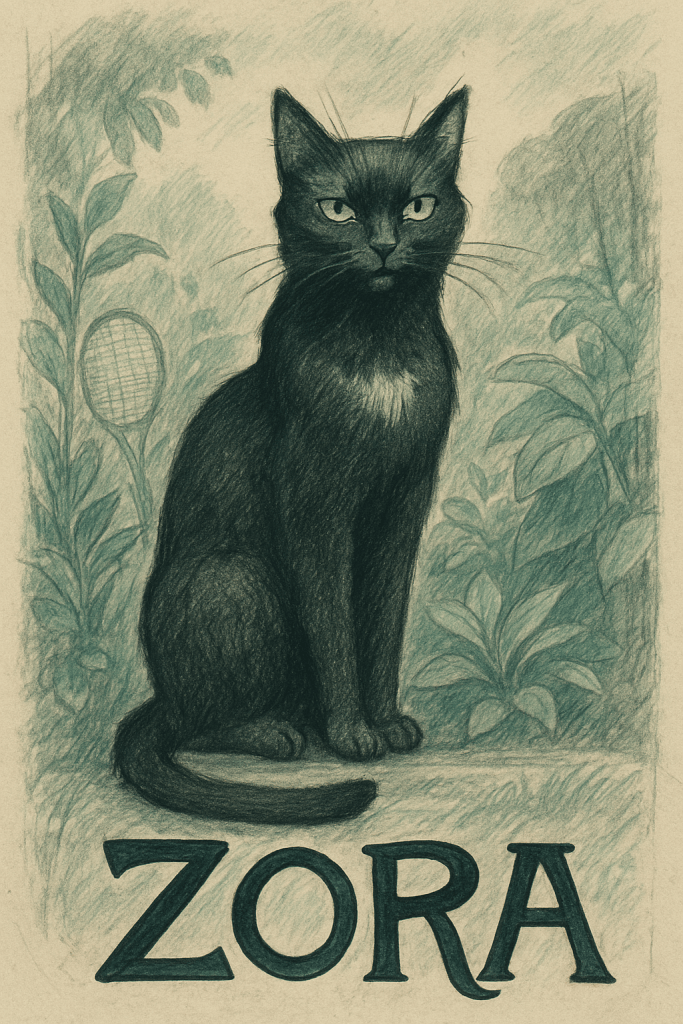
Purr, she said. Stretching to reveal a sprinkle of soft white speckled fur under her four long black legs. Stretching to solicit the warmth of the hot summer sun. A warmth that penetrated the window and radiated the sofa, the back of which was her preferred throne from which to examine the world. Lounging on her back, paws pushed out as far as she could reach, rotating herself to allow the sofa to slow-cook her sides, tummy and tail. Closing her eyes, purring herself into a deep meditative state, for this very old black cat was a feline of leisure. Not for her were the worries of survival. With a luxury home and the finest food provided by an adoring human, this postmodern cat had time to ponder the deeper meanings of life. She considered herself an anthropologist, a horticulturist, and above all, a huntress. Whilst she was intellectually advanced, she was like every other cat in many ways. She could be aloof, indulge in selective deafness, suffer from narcolepsy or live nocturnally, depending on her whim. However, on most days she rose early, enjoying a breakfast of kippers, lovingly prepared by her dear Mutti. Mutti being the cat’s name for her devoted keeper, an older woman who provided endless plates of food, love and affection. Mutti was by no means poor, keeping a Victorian townhouse on a quiet suburban street. A quiet life she shared only with her cat, since her husband had departed mysteriously some years before.
The cat listed lazily onto her side, listening to the summer silence. Quite by accident she closed her eyes and fell into a heavy sleep- the kind that only a cat could take for granted. When she woke, she found that the sun had abandoned her position. Instead, she could hear the tweeting of birds, causing her tummy to rumble and her claws to flex. She now had cat business to attend to. As dusk approached, there would be the chance to hunt, a stroll through the garden, to sniff the summer air and the highly pollinated plants. There would be the opportunity to mark territory and to prowl on other animals, in doing so upholding the rules of the animal kingdom. She would keep an eye on favoured neighbours and hide in ideal spots. The street on which she lived was a big world to explore and she shared it with few other animals.
Before the motivation to move became an irritable agitation on which she would have to act, there was an unexpected break in the silence, as her dear old Mutti called out: ‘Oh Zora, my beautiful black cat, how I’ve missed you’.
“Meow,” replied Zora, presenting her well-cooked tummy for Mutti to pet and stroke. A few moments of worship wouldn’t satisfy her hunger, but they might prompt Mutti to deliver food. And the dear old lady never failed, clattering through to the kitchen with the sole purpose of opening a tin of mackerel fillets. Zora’s nose tingled and her whiskers twitched.
-2-
Having eaten, Zora left via the cat flap into the warm summer evening air, embarking on her familiar route along the garden path — past the pond full of frogs, past a posse of rose bushes displaying different colours, many in bloom. A patch of daisies. A potted olive plant that, like Zora, wintered in the shelter and warmth of the old wooden-framed veranda. Past a zantedeschia and a geranium. A cluster of poppies, their seeds snatched by the squirrels — she mused at the thought of the little grey tails indulging in their opioid addictions.
Finally, she reached the tall red brick wall that marked the end of Mutti’s beautiful garden and, as such, the frontier of Zora’s animal territory. This was the point at which any other animal — be it cat, dog, or opiated squirrel — would be within their rights to take issue with Zora being there. Such are the rules of the animal kingdom, meaning that from this point on, Zora would have to be mindful of her actions.
Not that this stopped her, in this part of the world, she was high up in the animal kingdom. So rather than hiding away, the path she trod was highly visible. It involved navigating atop a wall which separated the long back-to-back gardens that belonged to the large Victorian townhouses of Mutti’s street. Each townhouse contained a family; each family, a different saga she could follow. Zora enjoyed the ups and downs, twists and turns of human household life. For her, it was a source of entertainment and intrigue.
Zora walked along the brick wall until reaching the end house. She jumped down into the garden of number 2, with the intention of making her way back slowly through each garden until she reached her own. Each garden was different, with its own smells, layouts, pathways, and tunnels. Zora wondered if the gardens reflected their owners — some were messy, whilst others were ordered. She knew them all; she knew the dangers, and most importantly, she knew the vantage points from which she could sit and watch the lives of her neighbours.
Zora sat on the wall that separated number 2 and number 4. From this vantage point, she could flick between the events of each home. The red brick wall was still warm, and the heat soaked up through her tummy, giving a satisfying glow.
Zora had liked observing the homes of numbers 4 and 6 especially — 4 being a pair of passionate lovers who indulged in endless conversation, whilst number 6 hosted numerous social gatherings. Zora loved the drama of both. But since the owner of number 6 had bought a vicious little dog, the allure had diminished, forcing Zora to trial other two-house combinations. So tonight, it was the wall between houses 2 and 4.
Number 4 sounded promising. The sound of music, cooking, and laughter was usually the prelude to a long, dispersive discussion over dinner in the garden. But of the other house, number 2, less was known. They hadn’t lived there long, and because a cat was already in residence — under the rules of the animal kingdom — this made the wall between numbers 2 and 4, where Zora was currently sat, strictly off-limits. But as Zora knew little of them, she was keen to learn. Two adults, two children, and a beautiful little cat: slender and white with grey tabby patches. She was elegant, whilst slightly wiry, in contrast to Zora, who was grandiose and regal.
On cue, the couple from number 4 appeared — smiling and laughing. They were youngish and smartly dressed. He’d cooked a Spaghetti Bolognese with a salad. She held a corkscrew, two glasses, and a bottle. He served the food at the garden table as she made the bottle pop before pouring two large glasses of red wine.
The couple entered a period of comfortable silence as they sat and ate. Zora watched, growing impatient at the lack of conversation. Being the sole audience member, she took it upon herself to heckle them into dialogue. ‘Meow.’ This interjection triggered a conversation, and it wasn’t long before Zora had worked her way onto the woman’s lap. The pair entered an impassioned debate, prompted by the infidelity of a mutual friend and neighbour. She was making her point so vigorously that her petting style was less a gentle stroking and more a violent poking and prodding.
‘All men are transgressors. It’s simple — you are all liars. All we women have to do is ask enough questions and eventually, we see that you are all built on ego. And that ego is the foundation on which your lives are built. And most of the time, that ego is a fantasy that has little in common with reality. Hence, all men are romantic with the truth — even you, my love.’
The man, feeling the need to defend himself, was equally forthright — agitating the woman and causing her to dig her fingers further into Zora’s flesh.
‘Women are all the same. Woman meets man. Woman seduces man. Woman lobotomises man. A woman in her home will set about de-skilling her mate, doing everything for him. She knows that this way, no other woman will want him. The man offers to help around the house, but talks over the division of labour fail. The man becomes redundant. The woman exhausts herself. Then she complains that her man is deskilled and unmotivated. She becomes unhappy that she has created a man who is different from the one she met. How does she solve the problem? Not by empowering her man — but by mocking him to her friends. Those same friends do the same to their men, and in turn, the men find salvation in golfing holidays. No wonder divorce rates are so high.’
‘You pig, you swine!’ she exclaimed in response.
This intense debate continued, but Zora had other things on her mind — such as how soft the fabric of the woman’s lap was, and how comfortably warm she felt despite the cooling of the summer evening’s air; how the taste of the Bolognese she’d scavenged had left her contented — and, all things considered, feeling rather sleepy.
 D. James Marten